ABOUT PERFORMANCE PAINTING
ABOUT PERFORMANCE PAINTING
“My work is not just the consequence of movement and experimentation, but testimony and memory of those events happening together”. Carla D’ Amato
ABOUT PERFORMANCE PAINTING
“My work is not just the consequence of movement and experimentation, but testimony and memory of those events happening together.” — Carla D’Amato
Performance Painting is a living approach—an authored practice where the artwork is the visible trace of an invisible process: presence under pressure, decision-making inside uncertainty, and the intelligence that appears when control is released.
It was born from the need to meet reality as it unfolds—without over-directing it, without forcing an outcome, without betraying what is happening in the moment. Over time, this exploration became a platform: a way of creating that merges contemporary art practice, embodied research, and principles I also master through other disciplines—resilience, nervous-system regulation, adaptive thinking, and the capacity to move forward without certainty.
To truly embody innovation, one must venture into uncharted territories, fully aware of the numerous challenges that lie ahead. This journey demands courage—not because it’s about breaking rules, but because it asks us to stop hiding behind them. It asks us to trust perception, timing, instinct, and structure at the same time. It asks us to become present enough to respond instead of react.
A PLATFORM, NOT ONLY A TECHNIQUE
When people first witness Performance Painting, they often describe it as “mesmerizing” because it contains a paradox: the work is deeply choreographed and deeply surrendered. It is disciplined, but not rigid. It is intentional, but not controlled. It is composed, yet alive.
That paradox is the core of the platform.
This practice expands beyond the studio into a wider field of application—because the exact skills it trains are the ones demanded by life, leadership, and collective creation:
- Staying present inside complexity
- Making decisions without over-control
- Reading signals (material, space, people, timing)
- Allowing evolution while holding structure
- Turning friction into creative intelligence
- Building resilience through action, not theory
- Fostering connection through allowance—meeting others as they are, releasing demand, and flowing with the moment
This is why Performance Painting is not “painting in a different way.”Is an immersive, interdisciplinary approach—where art becomes both an outcome and a method of human development.
THE BEGINNING: AN EXPLORATION OF THE PRESENT MOMENT
“Creating my own technique has been an immensely liberating experience, a transformative act that I refer to as PERFORMANCE PAINTING. It serves as a powerful metaphor for life and the ever-evolving present moment.”
The origin point is simple, and relentless: a blank canvas that is not only a surface, but a threshold—an interface between the internal world and the external conditions.
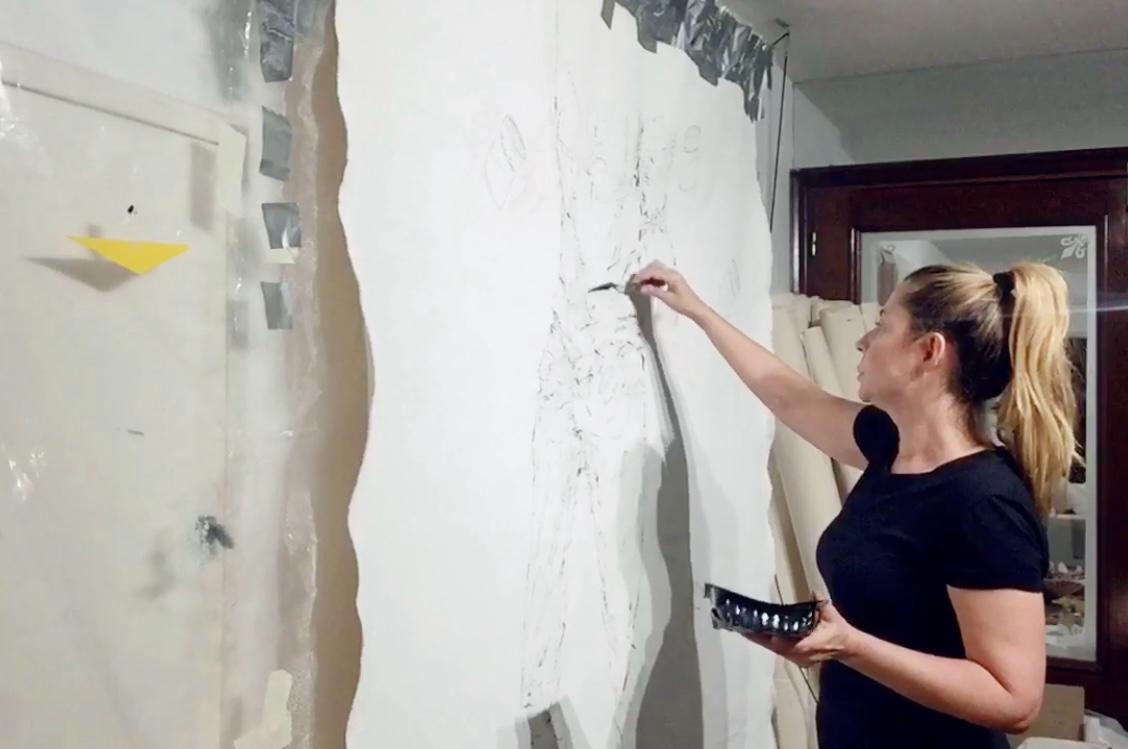
Imagine the canvas suspended vertically, shifting the rules of gravity, time, and control. The paint becomes a collaborator rather than a substance to dominate. Watered pigment slides, drips, accelerates—almost demanding urgency. The medium refuses the comfort of pause. It forces presence.
This is not “chaos.” It is reality: fluid, changing, sometimes brutal in its speed. And it requires a particular type of intelligence: the ability to act clearly while the conditions are moving.
That is where Performance Painting begins.
WHAT MAKES IT NON-CONVENTIONAL
Non-conventional does not mean rebellious for the sake of rebellion. It means the work is created through adaptive orchestration rather than fixed control.
In Performance Painting, the artwork emerges from a sequence of relationships:
- The support (treated, prepared, activated)
- The vertical space (the canvas placed as a body in the room)
- The artist’s body (movement, pressure, timing, breath)
- The material (viscosity, gravity, speed, absorption)
- The environment (sound, temperature, audience presence, context)
- The moment (unrepeatable decisions that can’t be re-staged)
is why the process is not “mere representation.” It is an event. A lived situation. A real-time negotiation between intention and what reality allows.
And because the conditions cannot be fully controlled, the work becomes a training in:
- letting go without collapsing
- acting without forcing
- holding a vision without clinging to it
- creating coherence while allowing surprises
- turning mistakes into portals
That’s resilience—not as a motivational phrase, but as real operational strength
THE PROCESS: FROM RITUAL TO IMPACT
Every piece begins before the first stroke.
The canvas is not neutral: it is prepared, treated, and positioned with precision. In this practice, the support “takes a place” in the space—almost like a participant entering the room. Suspended like a loose element and the surrounding air all become part of the final language.
Then the action begins.
The work is built with palette-knife gestures—grand-scale figures as in “Traces of the Present Moment” and “Within the Depths of Strength.” Other times the piece grows through subtle mixed-media layering and textured atmospheres, as in “Happening Now.”
But the principle remains constant:
the artwork is the testimony of a lived state.
Not an illustration of an idea, but a consequence of presence , of flowing with the situation.
This is why the studio hours matter. The repetition, the rigor, the endurance—these become visible as character, as density, as a kind of seriousness that the canvas remembers.
In Performance Painting, the canvas absorbs more than pigment: it absorbs timing, attention, emotional charge, restraint, risk, and recovery.
MOVEMENT, STILLNESS, AND THE POWER OF “NOT DOING”
What sets this work apart is not only movement, is the dialogue between movement and stillness.
There are moments in the performance where the strongest decision is to pause—to not overcorrect, not to chase perfection, not to fight what is already happening. This is where the discipline of non-control becomes visible: the willingness to allow the image to arrive instead of being forced.
This is a principle I also bring from coaching frameworks: growth doesn’t happen through domination of the self. It happens through a wiser relationship with the self—one where intensity is guided, not unleashed blindly.
That’s why Performance Painting often feels like a mirror to the viewer: it carries the signature of human experience—effort and surrender, desire and restraint, certainty and doubt, shadow and light.
FIGURATIVE + ABSTRACT: THE LANGUAGE OF THE IN-BETWEEN
Performance Painting holds a mesmerizing convergence of the figurative and the abstract—because life itself is exactly that: partly visible, partly unknown.
You will encounter large-scale figures that command space and presence. They occupy the room with authority. They open a dialogue with the collective.
And then, up close, a more abstract language reveals itself: strokes and hundreds of subtle marks that invite a more intimate encounter—its in-betweens and negative spaces, the pauses, the voids that hold meaning. Like in certain Japanese principles of composition, emptiness is not “nothing.” It is a field of significance. It is where interpretation becomes personal. It is where the viewer enters.
This is intentional: the work is not meant to dictate. It is meant to activate.
THE VIEWER’S ROLE: AN IMMERSIVE DIALOGUE
Engaging with these artworks is an invitation to move—not only physically, but internally.
As you walk around the piece, the work shifts. Texture changes. Light reveals hidden layers. The narrative opens in stages. The viewer becomes a participant, not a consumer.
This is not mere entertainment. It is an experience of perception—an encounter with how meaning forms.
And when Performance Painting is presented as a live action, the dialogue expands: the audience is no longer observing a finished object; they are witnessing the emergence of a result from uncertainty.
That witnessing creates something collective: a shared introspection that transcends the boundaries of space and time.
THE OUTCOME: A COLLECTABLE WORK WITH A CURATORIAL FRAME
Performance Painting produces an outcome that is both ephemeral and permanent:
- The ephemeral event: the performance, the action, the moment
- The permanent residue: a collectable artwork—unique, layered, unrepeatable
- The curatorial structure: a clear conceptual framework, series language, and material rigor
- The documentation: photography, video, and narrative that preserve the living dimension of the process
In other words: the work is not only the painting. The work is the full ecosystem—process, presence, context, and artifact.
WHY THIS MATTERS NOW
We are living in an era where the old myth of control is collapsing. The world moves too fast. Systems shift. Identities evolve. Markets change. Relationships reconfigure.
Performance Painting is not a response of fear. It is a response of mastery: how to create in motion.
How to move through challenge without becoming rigid.
How to meet uncertainty without losing your center.
How to hold vision while allowing life to participate.
That is why this platform belongs not only to the studio, but also to institutions, organizations, and communities—because it is, at its core, a methodology of human capacity expressed through contemporary art.
PERFORMANCE PAINTING – WHERE IT LIVES
This approach expands into a platform with multiple applications, always adapted to context and scale:
- Institutional & Museum Programs: performative exhibitions, immersive programs, site-specific commissions, and public programming.
- Business Innovation & Leadership: performative keynotes and creative labs for innovation, culture, cohesion, communication, and adaptive leadership.
- Community & Education Bridge: participatory programs where art becomes a bridge for belonging, expression, and purpose—especially for youth.
Each expression keeps the same signature: a non-conventional approach that doesn’t glorify disruption—it glorifies aliveness, intelligence, and the courage to create with what is real.
 Carla D'Amato